

TL;DR – Executive Summary for Facilities Managers
Commercial overhead doors are essential for daily workflow, inventory security, and climate control in industrial and commercial facilities across Lincoln. Key safety and maintenance priorities include:
- Daily Safety Protocol: Keep door travel paths clear of pallets/equipment, inspect safety sensors daily, and restrict door operation strictly to trained personnel.
- Preventive Maintenance Schedule: Schedule semi-annual professional inspections for high-cycle springs, lift cables, commercial tracks, and auto-reverse safety mechanisms.
- Fire Door Compliance: Annual certified drop testing is mandatory for fire-rated commercial doors under NFPA 80 guidelines.
- Bottom Line: Regular preventive servicing minimizes costly operational downtime, extends high-cycle hardware lifespan, and keeps your business compliant with workplace safety regulations.
From manufacturing plants and distribution hubs in Air Park to retail storefronts in Downtown Lincoln and automotive bays along Highway 77, commercial overhead doors keep Lancaster County businesses moving. These heavy-duty doors operate dozens, sometimes hundreds, of times per day, carrying significant structural weight under intense spring tension.
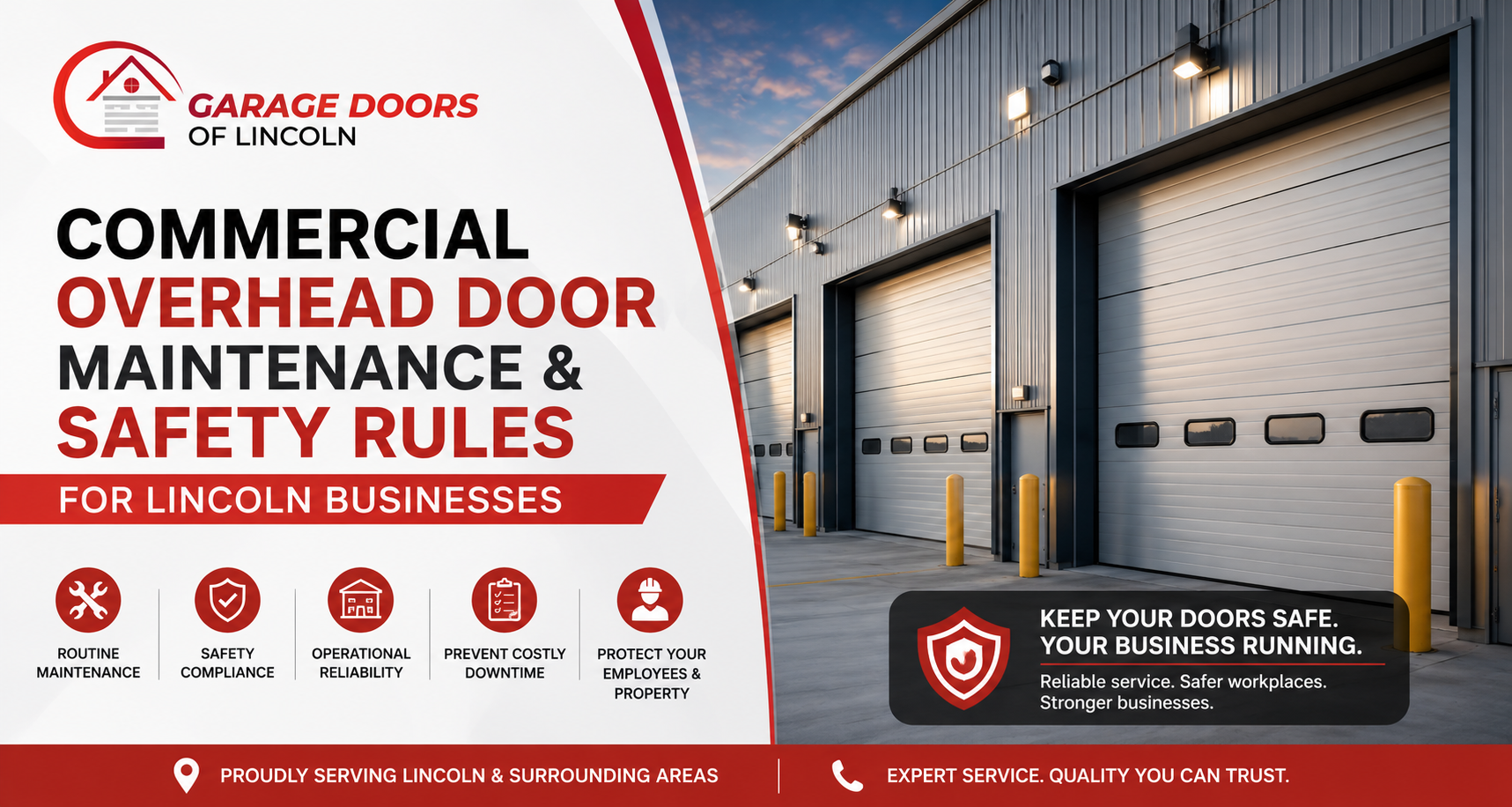
When a commercial door breaks down, operations come to a halt. Worse, an unmaintained commercial door poses severe liability risks to employees and property. Establishing proactive safety rules and routine maintenance protocols with Garage Doors in Lincoln ensures your facility stays operational, safe, and fully compliant with industrial workplace standards.
Critical Workplace Safety Rules for Commercial Overhead Doors
Establishing clear operational safety rules is the first line of defense against workplace accidents and equipment damage in commercial facilities.
Workplace Safety Mandate:
Never allow employees to walk or drive under a moving overhead door. All personnel must wait until the door reaches its fully open horizontal position before passing through loading bays or service entrances.
1. Clear Clearance Zones
Keep the floor space surrounding commercial door tracks completely free of forklifts, wooden pallets, inventory staging boxes, and trash bins. Objects left near track channels can cause rollers to derail or trigger photo-eye sensors, causing sudden auto-reversals or motor burnouts.
2. Restricted Operator Access
Wall-mounted push-button stations and commercial remote controls should be operated strictly by trained staff. Operator controls should be mounted at least 5 feet above floor level so unauthorized personnel or visitors cannot accidentally trigger door movement.
3. Workplace Safety Compliance
Commercial overhead doors must adhere to general industrial safety regulations set forth by the Occupational Safety and Health Administration (OSHA) regarding machine guarding, clear egress routes, and hazard prevention in materials handling areas.
Commercial Maintenance Checklist: Prevent Costly Downtime
Commercial doors utilize industrial-grade hardware designed for high cycle counts. However, heavy daily usage requires structured preventive maintenance.
| Maintenance Task | Frequency | Action Items |
|---|---|---|
| Visual & Photo-Eye Inspection | Daily / Weekly | Wipe dust off photo-eye lenses; verify red/green indicator lights; check tracks for debris. |
| Track & Roller Lubrication | Monthly | Apply commercial synthetic lubricant to steel roller bearings, track curves, and hinge pins. |
| Spring & Cable Strain Check | Quarterly | Inspect high-cycle torsion springs for coil gaps; check heavy-duty lift cables for fraying or rust. |
| Professional Safety Inspection | Semi-Annually | Full physical evaluation of opener motor gears, shaft couplings, spring tension, and track alignment. |
To avoid unexpected bay lockouts, schedule routine preventive garage door service to catch component fatigue before hardware breaks under load.
NFPA 80 Fire Door Drop Testing Requirements
If your Lincoln business utilizes rolling steel fire doors or fire-rated counter shutters to prevent flame propagation between building zones, you are legally required to undergo regular compliance testing.
According to strict safety standards established in the NFPA 80 Standard for Fire Doors and Other Opening Protectives, commercial fire doors must undergo annual drop testing by a trained technician. This process verifies that:
- The fire door automatically releases and closes fully upon thermal fuse melting or fire alarm signal activation.
- The door closes at a controlled rate of speed (between 6 inches and 24 inches per second).
- The auxiliary spring mechanism resets properly after the drop test is complete.
Facility managers must keep written inspection records on-site for local fire marshal inspections.
Handling Forklift Impact Damage & Emergency Repairs
One of the most common emergencies in industrial warehouses is a forklift or delivery truck colliding with a partially open overhead door. Collision impact can buckle steel panels, bend track channels out of plumb, or snap lift cables.
What to Do Immediately After an Impact:
- Stop Operation Immediately: Do not attempt to push the automatic button to open or close a bent door. Forcing a derailed door can burn out the commercial motor or cause the entire assembly to collapse.
- Clear the Area: Disconnect power to the opener motor and mark the bay as out-of-service with caution tape.
- Call for Professional Repair: Contact certified technicians equipped for immediate garage door repair to safely un-wedge panels, realign commercial tracks, or replace damaged section hardware built to DASMA industrial standards.
Frequently Asked Questions (FAQ)
How often should commercial overhead doors be professionally serviced?
Commercial doors should receive a professional inspection at least twice per year (semi-annually). Facilities operating 24/7 with high daily cycle counts (such as distribution logistics centers or emergency bays) should schedule quarterly maintenance service.
What is high-cycle spring rating for commercial doors?
Standard residential torsion springs are rated for roughly 10,000 cycles. Commercial doors use heavy-duty high-cycle springs engineered for 25,000, 50,000, or even 100,000 cycles to withstand constant daily opening and closing without fatigue failure.
Can our facility maintenance staff repair commercial door springs?
No. Commercial torsion springs store tremendous kinetic energy and can cause catastrophic injury or severe property damage if adjusted without specialized winding tools. Spring replacement should strictly be left to certified commercial door technicians.
Why does my commercial door auto-reverse before hitting the floor?
This usually indicates misaligned photo-eye sensors, dirty lenses, or incorrect down-limit switch settings on the commercial opener motor. It can also occur if heavy dust or floor debris breaks the sensor beam path as the bottom seal approaches the floor.